
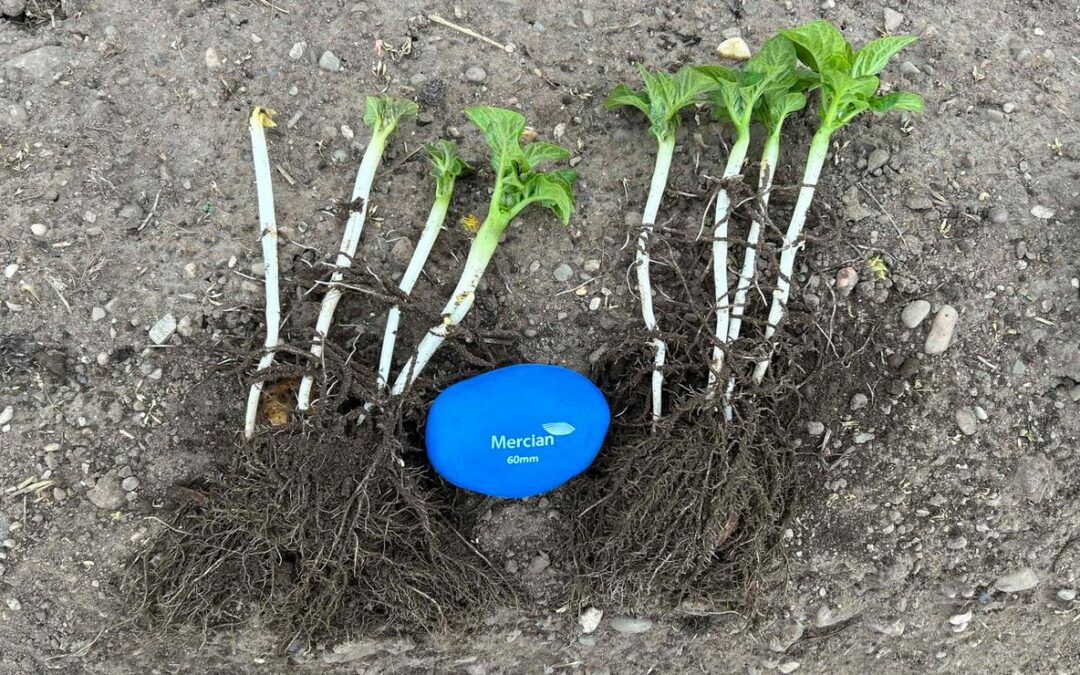
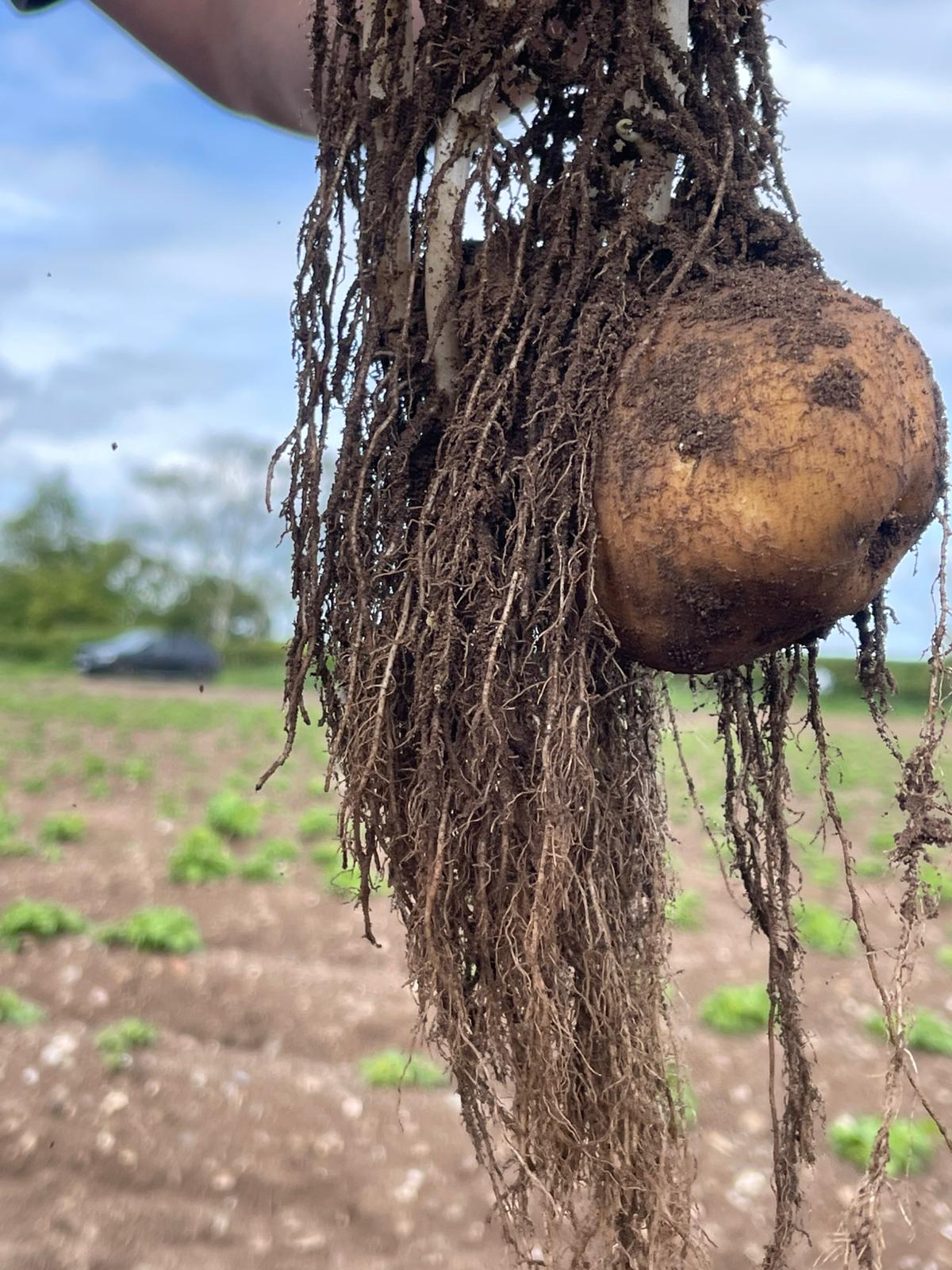
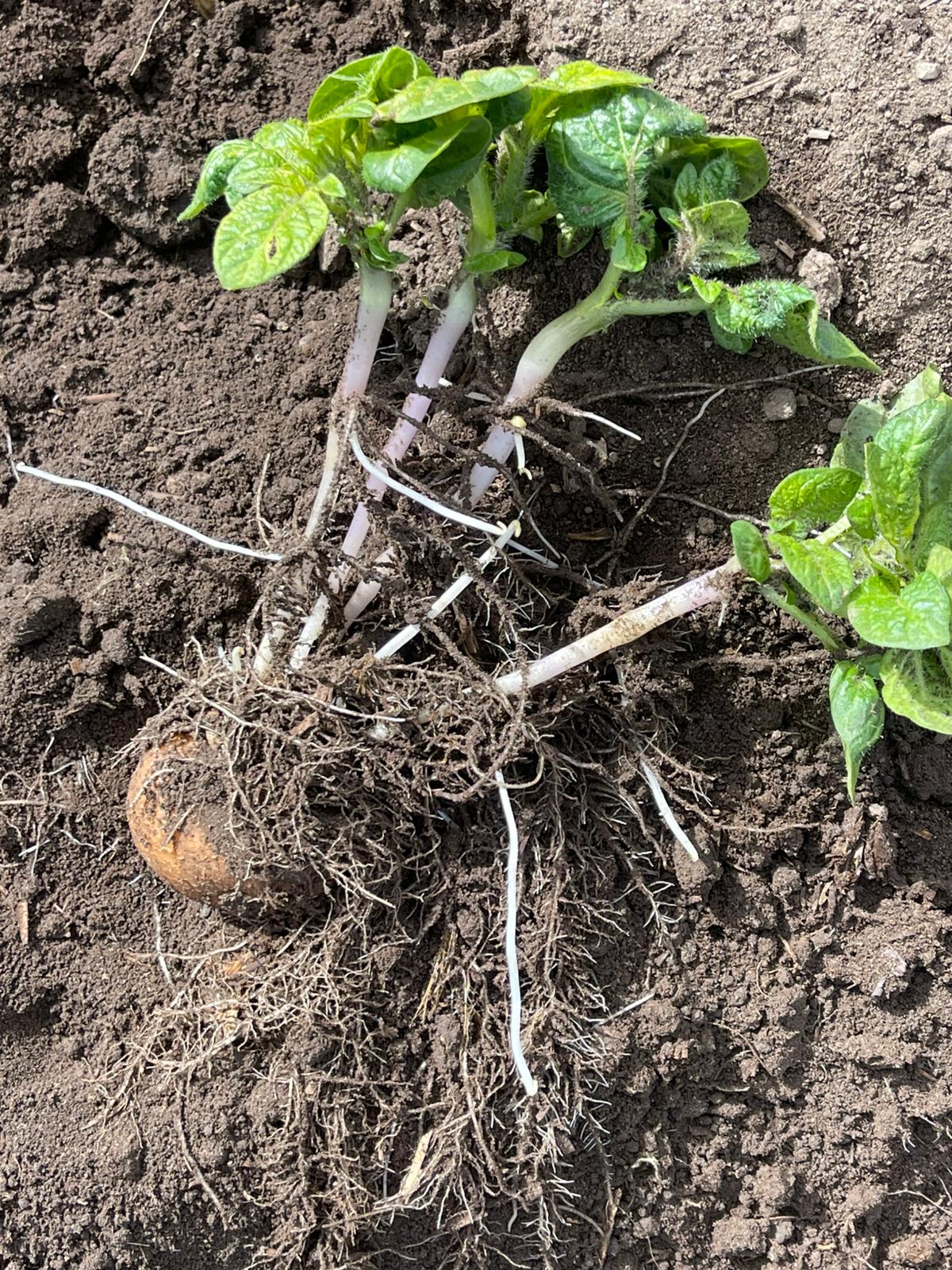
Early field observations from two commercial crisping potato crops treated with Symposium are showing dense, fibrous rooting, fresh white root tips and active development below ground.
These are encouraging signs during establishment because the strength of the root system influences how effectively the crop can access moisture and nutrients as it moves towards stolon formation, tuber initiation and bulking.
The crops were inspected on 19 May 2026. One was an early maincrop crisping variety planted on 22 April, while the other was a commercial crisping variety planted on 25 March. Sample digs from both crops showed well-developed root systems for their respective stages.
These images are field observations rather than a replicated treatment comparison, so root appearance alone cannot demonstrate a quantified yield response. They do, however, provide a useful view of how the treated crops were establishing and illustrate the below-ground characteristics growers and agronomists want to see early in the season.
Why strong potato root development matters
Canopy growth is the most visible sign of crop progress, but crop performance begins below ground.
During establishment, the potato plant must develop enough active root surface to explore the soil and support rapidly increasing demand above ground.
A strong root system can help the crop:
- Explore a greater volume of soil for available moisture.
- Access both mobile and less-mobile nutrients.
- Support early canopy growth and photosynthetic capacity.
- Provide the foundation for stolon development and tuber initiation.
- Cope more effectively with periods of uneven moisture and other environmental pressures.
In potatoes, this early development is particularly important. The crop has a relatively shallow root system compared with some arable crops, so establishing an active and well-distributed root network can help it make better use of the available soil volume.
What do fine, fibrous roots indicate?
Fine roots increase the surface area in contact with the soil. This gives the crop more opportunity to encounter moisture and available nutrients across the developing root zone.
Fresh white root tips are an indicator of active root growth, while a dense, fibrous structure shows that the crop is developing a wider network of roots through which water and nutrients can be absorbed.
These are important characteristics during potato crop establishment. The plant needs a strong below-ground structure to support the developing canopy and prepare for stolon growth, tuber initiation and subsequent bulking.
How Symposium supports the developing potato root zone
Symposium is a concentrated microbial biostimulant containing active rhizobacteria, beneficial fungi and organic biostimulants.
It is applied at planting so that these components are positioned close to the seed tuber and developing roots.
This is an important distinction. Symposium does not simply aim to stimulate the microbial populations already present in the soil. It introduces selected beneficial microorganisms directly into the developing root zone.
These microorganisms are combined with organic biostimulants that act as an initial food source for the microbes while also working as active rooting stimulants in their own right.
At the recommended application rate, each hectare receives approximately 70 trillion viable microbes. The species and individual strains have been selected for their role in supporting the developing crop and the biological environment around its roots.
The relationship between potato roots, microbes and nutrient access
Root development and root-zone biology are closely connected.
Roots release compounds into the surrounding soil, while beneficial microorganisms interact with the root surface and nutrients within the root zone. A biologically active rhizosphere can support nutrient cycling and help make certain nutrients more accessible to the crop.
This relationship can help support:
- Early root growth and root mass.
- Greater exploration of the soil.
- Access to nutrients including phosphate, manganese, sulphur and iron.
- Natural nitrogen fixation within the root zone.
- Improved interaction between the roots and surrounding soil.
- Better access to moisture through stronger root development.
However, microbial biostimulants do not replace the need for sound soil analysis, balanced fertiliser planning or careful in-season crop monitoring.
They work best as part of an integrated agronomy programme in which soil conditions, crop variety, nutrition, water availability and application timing are considered together.
Field observations from two crisping potato crops
The first sample came from an early maincrop crisping variety planted on 22 April 2026 and inspected on 19 May.
The second came from a commercial crisping variety planted on 25 March and inspected on the same date.
Across the sample digs, the visible features included:
- Dense, fibrous root mass.
- Fresh white root tips showing active growth.
- Good root distribution around the developing plant.
- A strong below-ground structure at establishment.
Taken together, these are positive indicators of crop vigour at the time of inspection.
Continued monitoring through canopy development, tuber initiation and bulking will help show how this early root development translates into later crop performance.
Commercial crisping variety planted on 25 March '26 & inspected 19 May '26
Early maincrop crisping variety planted on 22 April '26 & inspected 19 May '26
Early rooting helps build resilience before stress occurs
Heat, dry periods and uneven rainfall can place potato crops under pressure quickly. By the time visible stress appears in the canopy, the crop may already have lost valuable growth.
Supporting root development at planting is therefore a preventative agronomy decision. The aim is to improve the crop’s capacity to find water and nutrients before conditions become limiting.
A larger root mass cannot remove the effects of severe drought or replace irrigation where it is required. However, it can give the crop a stronger platform from which to manage short-term variability and maintain growth.
This is why applying beneficial microbes at planting should be considered as part of establishment and crop resilience planning, rather than simply as a response to visible crop stress.
A strong start below ground
Simon Fox, CEO of Emerald Research, said:
“Root development is one of the clearest indicators of how well a potato crop is establishing, but more importantly, it helps set the potential for the crop. What we are seeing here is the kind of strong, active rooting we want at this stage of the season.
“Symposium introduces active beneficial microbes into the root zone alongside organic biostimulants, helping to create the right conditions for establishment. A healthy root system gives the crop a stronger platform to access nutrition, manage moisture and support growth above ground.”
The message for growers is straightforward: early crop potential is built below ground as well as above it.
These field observations show encouraging rooting in the Symposium-treated crops and provide a useful reminder to assess potato crop establishment by looking beneath the canopy.