
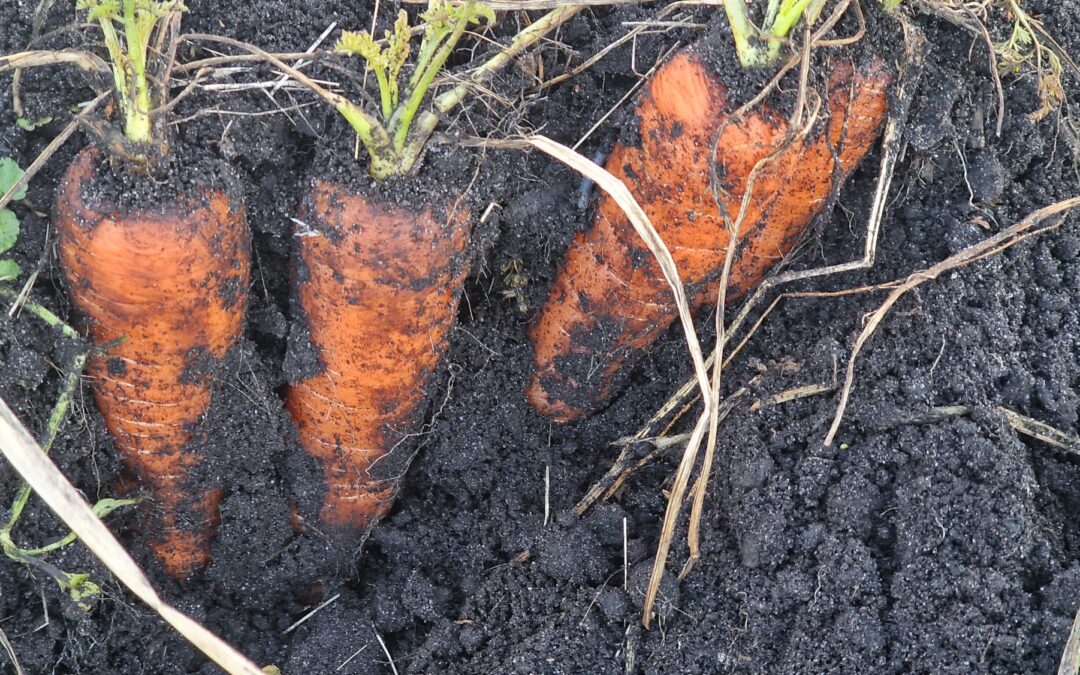
Root crop agronomy is not just about potatoes
Emerald Research Ltd (ERL) has built much of its crop work around potatoes, and for good reason. Potatoes are a technically demanding root crop where soil health, nutrition, rooting, stress resilience and marketable yield are closely linked.
But those challenges are not unique to potatoes.
Across the wider root crop and field vegetable sector, carrot growers and vegetable agronomists are facing many of the same pressures: variable soils, increasing disease pressure, changing weather patterns, tighter input choices and the need to produce consistent, marketable crops.
ERL has always provided expertise across a broad range of crops and that includes other root crops, including carrots.
Why carrots and potatoes share common agronomy challenges
Potatoes and carrots may be very different crops, but they have several important things in common.
Soil condition, rooting and marketable crop quality
Both depend heavily on what happens below ground. Root structure, nutrient availability and soil condition all play a major role in crop performance. Soil condition can include soil structure, soil strength, porosity, mineral composition, compaction, microbial activity, and soil and water movement. All of which greatly influence crop performance long before final yield is measured.
Both crops are also judged commercially on quality as well as weight. A crop can produce good biomass, but if the harvested product does not meet market specification, the financial return may be greatly reduced.
In potatoes, that may mean issues with tuber size, skin finish, dry matter or stress-related defects. In carrots, shape, cavity spot and root quality can make the difference between a saleable and rejected crop.
What the ERL carrot trial showed
A recent replicated carrot trial carried out by ERL looked at programmes combining SL 567A with Consortium-Plus, the predecessor to their current microbial biostimulant, Symposium.
The trial focused on cavity spot suppression, reject reduction and marketable yield.
Reduced rejects and improved marketable yield
The most striking result came from the post-emergence treatment. Across three replicated plots, this treatment recorded zero rejects, compared with an average of 8.4% rejects per plot in the untreated control.
The post-emergence programme also produced a higher total marketable weight, averaging 9.72 kg per plot compared with 6.93 kg in the untreated plots. This represented a 40.3% improvement in marketable weight.
For growers, this is the important point: the treated crop produced more saleable crop and fewer rejects.
Why soil biology matters in carrot and root crop production
The carrot trial supports a wider principle that ERL has seen repeatedly in potatoes: better crop performance starts with the root environment.
A root crop is only as strong as the system supporting it. That includes:
- The biology around the root
- The crop’s ability to access nutrients and moisture
- The strength and resilience of developing root tissue
- The plant’s ability to cope with stress and disease pressure
- The timing and balance of nutrition
Microbial biostimulants such as Symposium are designed to support the biological side of this system. They do not replace good agronomy, but they can form part of a wider programme aimed at improving crop resilience and supporting yield quality.
Applying potato agronomy experience to carrots and other field vegetables
ERL’s work in potatoes has focused heavily on practical, field-based crop support: soil analysis, leaf and petiole testing, microbial inputs, foliar nutrition and stress resilience.
The same thinking can be applied to other root crops.
Carrots, parsnips, beetroot and other field vegetables all rely on healthy soils, strong root development and carefully timed nutrition. They are also exposed to many of the same environmental pressures that potato growers are already managing, including dry periods, heat stress, soil variability and changing disease risk.
This does not mean treating every crop the same. Each crop needs its own agronomy, timings and technical understanding. But the underlying approach is similar: use better information, support the plant earlier, and build resilience into the crop before problems become visible.
Why integrated crop management matters for carrot growers now
Growers are under pressure to produce reliable crops with fewer easy answers. Chemistry alone is not always enough, and biological products need to be used as part of a properly thought-out programme.
That is where integrated crop management becomes important.
By combining soil data, crop monitoring, targeted nutrition and microbial support, growers can make more informed decisions and give crops a better chance of reaching their marketable potential.
The carrot trial is an important step in showing how ERL’s experience in potatoes can be applied more widely across the root crop sector.
Conclusion: building resilience in high-value root crops
ERL’s carrot trial showed encouraging results, with the strongest treatment reducing rejects to zero across replicated plots and increasing marketable weight compared with the untreated control.
While more trial work is needed, especially using the newer Symposium formulation, the study gives a clear direction: the principles of strong root development, soil biology and crop resilience are just as relevant in carrots as they are in potatoes.
ERL has long had a strong focus on potatoes. However, this and other trials from recent years demonstrate how the same science-led, practical agronomy approach can be applied to other high-value root crops