
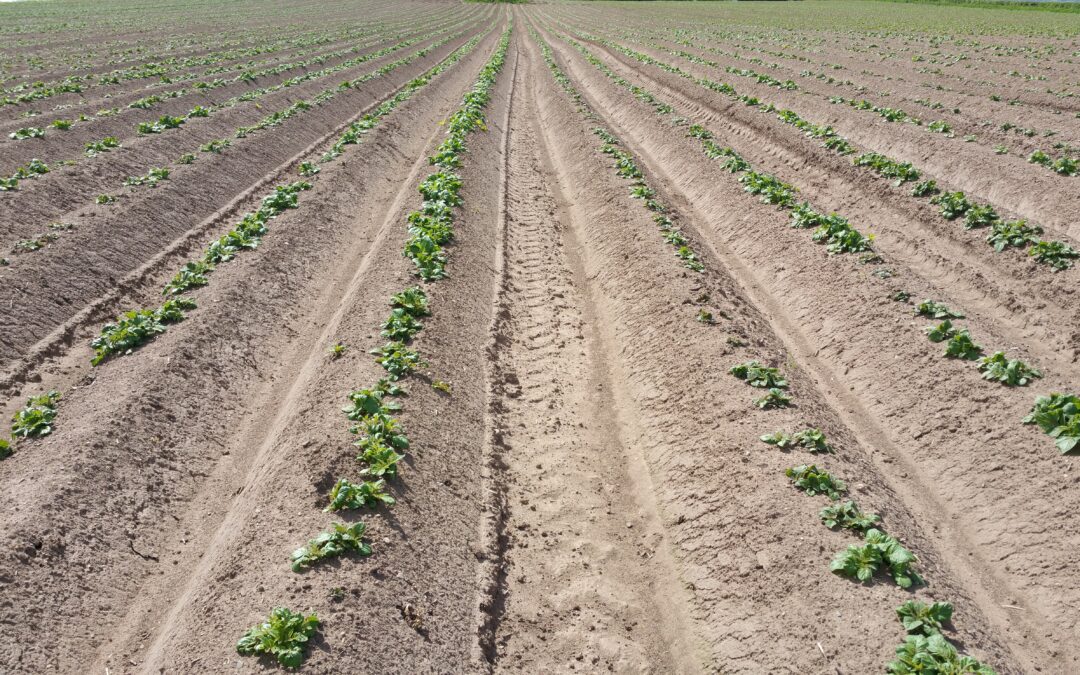
Microbial Mixes at Planting and Potato Crop Establishment
For potato growers and agronomists, microbial mixes at planting should be viewed as part of establishment risk management — supporting root development, nutrient access and resilience before the crop comes under pressure.
Most discussions around microbial products focus on yield uplift. But in potato crops one of the biggest advantages of applying a microbial mix at planting is something less visible – risk and resilience management during establishment.
This is a different way of looking at products like Symposium.
Planting Is a Disruptive Event for Soil Biology
Cultivation, bed forming and planting disturb soil structure and microbial populations. At the same time, the crop is at its most vulnerable – with limited roots, restricted nutrient access and exposure to cold or wet conditions.
Applying a microbial mix at planting helps rebuild biological function around the seed tuber and in the root zone when the crop needs it most.
How Beneficial Microbes Support the Root Zone
Microbes as a Buffer Against Variability
Rather than simply “boosting” growth, microbial mixes help stabilise early crop performance by:
Improving root-soil interaction
- Beneficial microbes support finer root systems and better soil contact, improving water and nutrient uptake in variable conditions
Supporting nutrient flow, not just supply
- Microbes mobilise existing nutrients in the soil profile, helping crops access phosphorus, iron, sulphur and manganese during early growth.
Enhancing resilience to stress
- Healthier root systems and balanced microbial populations help crops cope with cold soils, uneven moisture and early nutrient stress.
Consistency, Uniformity and Establishment Risk
From an agronomy perspective, microbial mixes at planting are less about chasing peak yields and more about:
- Reducing variability across fields
- Improving crop uniformity
- Lowering early-season establishment risk
- Supporting crops through unpredictable spring conditions
- Improving crop resilience and drought endurance
In potatoes, strong establishment will translate directly into more consistent tuber set, size profile and marketable yield.
In seasons where cold soils, dry conditions or uneven emergence can quickly affect crop potential, supporting the biology around the seed tuber is a practical way to improve consistency from the start.
Why Symposium Fits UK Potato Establishment Programmes
Beneficial microbes are depleted in many UK soils. Symposium contains high concentrations of beneficial microbes combined with powerful organic nutrients that restore soil health around the developing crop root mass. Applied at planting, Symposium helps rebuild a functional, balanced root-zone biology that supports the crop through its most sensitive growth stage.
Final Thought: Microbial Mixes as Part of an Establishment Strategy
Think of microbial mixes not as an “extra input”, but as part of your establishment strategy – working quietly in the background to improve quality, consistency, resilience and efficiency from day one.
For growers looking to reduce establishment risk and improve early crop resilience, Symposium can be used as part of a wider OptiYield potato nutrition programme. Speak to Emerald Research about how microbial support, soil analysis and targeted nutrition can be built into your planting strategy.
Related Reading:
Microbes and Potatoes: The Key to Healthier Soil, Stronger Roots and Drought Resilience
Symposium Launched as Emerald Research Rebrands Consortium Plus
How Seaweed Extracts Help Potatoes Cope with Water Stress
Potato Petiole Analysis: Staying on Track from Emergence and Beyond
Fertiliser Prices & Potato Nutrition: Smarter Nutrient Strategy