
Leaf Tissue & Petiole Analysis
Leaf Tissue Analysis, Petiole Testing & Nutrient Monitoring for Potato Crops
Leaf tissue analysis gives farmers and agronomists a real-time picture of a crop’s nutritional status during the growing season. In potato crops, petiole analysis is particularly valuable because the petiole acts as the plant’s nutrient highway, carrying nutrients from the roots to the leaves. By analysing what the crop is actually taking up, rather than relying on soil supply alone, growers can make more informed decisions on nutrition, foliar applications and fertiliser efficiency.
Used at the right growth stages, leaf tissue and petiole testing can identify hidden hunger before visual deficiency symptoms appear, helping to protect marketable yield, tuber quality, skin finish, dry matter and overall crop performance.
It is a practical tool for managing nutrition proactively rather than reacting after performance has already been affected.
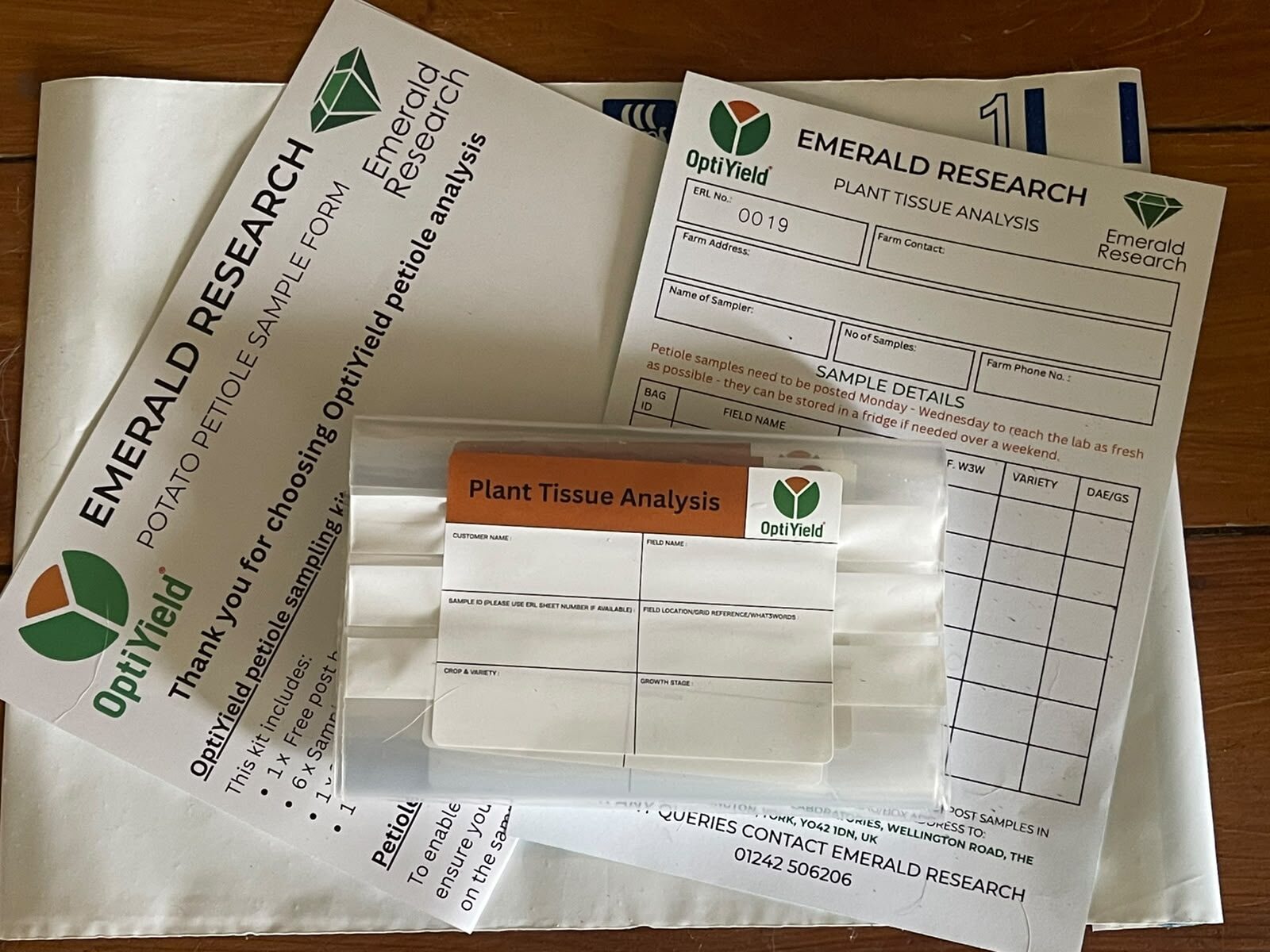
OptiYield leaf tissue & petiole sampling kit
Emerald Research offers complimentary leaf tissue and petiole analysis, interpretation and, where appropriate, a remedial action plan for existing customers. For non-customers, leaf tissue analysis, interpretation and remedial recommendations are charged at £50 per sample analysed.
Order your OptiYield leaf tissue/petiole sampling kit by completing the form below:
The kit includes:
- 1 x Free post bag for 6 samples
- 6 x Leaf tissue /petiole sampling bags (1 bag per sample)
- 1 x 2 part carbon copy sampling form
- 1 x Instruction leaflet
Please ensure you complete the address so we can send the kit to you, along with phone number and e-mail so we can get back in touch with your leaf tissue analysis results.
Why carry out leaf tissue or petiole analysis?
Leaf tissue and petiole analysis gives farmers and agronomists a real-time picture of what the crop is actually taking up during the growing season. Soil analysis shows what nutrients may be available in the soil, but tissue testing shows what the plant has been able to extract and use.
This makes it a valuable in-season decision-making tool, especially during key growth stages when nutrient demand has a direct effect on yield, quality and marketable output.
Identify hidden hunger before symptoms appear.
Many nutrient deficiencies are not visible in the early stages. By the time a crop shows pale leaves, stunted growth, deformed margins or distorted new growth, the deficiency is already well established and may have started to limit performance.
Regular leaf tissue or petiole analysis can identify hidden hunger, nutrient imbalances or antagonisms before visual symptoms appear, giving growers the opportunity to take action while there is still time to influence crop performance.
Support better nutrition decisions.
When results are interpreted alongside soil analysis, crop growth stage and variety-specific nutrient demand, leaf tissue analysis can help growers decide whether corrective nutrition is needed, where inputs can be optimised, and whether foliar or fertiliser programmes are matching crop demand.
This helps support crop health, tuber development, quality, dry matter, skin finish and overall fertiliser efficiency.
Benefits for farmers and agronomists of leaf tissue analysis.
Leaf tissue and petiole analysis can help to:
- Monitor crop nutrient status during the season
- Identify hidden nutrient deficiencies before visual symptoms appear
- Support decisions on foliar nutrition and fertigation
- Match nutrient supply to crop growth stage and variety demand
- Avoid unnecessary or poorly timed applications
- Improve fertiliser efficiency and input value
- Support tuber bulking, skin finish, dry matter and bruising resistance
- Protect marketable yield and crop quality
When to use leaf tissue analysis.
Sampling should begin early enough to allow meaningful nutritional adjustments. In potato crops, this is usually after tuber initiation and as bulking begins. Regular testing through the season provides a clearer picture of nutrient trends and helps growers understand how the crop is responding to soil conditions, weather and applied nutrition.
How to take a potato petiole sample.
For potato petiole analysis, select the 3rd or 4th fully emerged leaf from the plant. Remove the leaflets and retain the petiole. Collect approximately 40 petioles from representative plants across the field, sampling at regular intervals down one row and back up another.
Samples should be sent to the laboratory as fresh as possible. Ideally, take samples from Sunday to Wednesday and post them immediately to avoid delays over the weekend, especially during hot weather.
Turning results into action.
A single analysis figure is only useful when it can be interpreted in context. The greatest value comes when leaf tissue or petiole results are combined with soil analysis, crop growth stage and variety-specific nutrient demand information. This allows growers and agronomists to assess whether the crop has access to the right nutrients, in the right ratios, at the right time.
The result is better-informed crop nutrition planning, more targeted interventions and a stronger basis for weighing up the cost, yield and quality benefit of any nutrient application.
Frequently Asked Questions – Leaf tissue & petiole analysis
What is leaf tissue analysis?
Leaf tissue analysis measures the nutrient levels within the plant during the growing season. It helps show what the crop is actually taking up and using.
What is petiole analysis?
Petiole analysis is a type of plant tissue testing. In potatoes, the petiole is commonly tested because it carries nutrients between the roots and leaves, giving a useful snapshot of the crop’s nutritional status.
Why is petiole analysis useful in potatoes?
Potatoes are high-demand crops and can be sensitive to nutrient shortfalls or imbalances. Petiole analysis helps identify issues before visible symptoms appear, supporting timely nutrient decisions.
When should potato crops be sampled?
Sampling should start early enough to allow corrective action, often after tuber initiation and as bulking begins. Regular sampling through the season gives the most useful trend data.
Can leaf tissue analysis improve fertiliser efficiency?
Yes. By showing what the crop is actually taking up, tissue analysis helps growers avoid unnecessary applications and target nutrients where there is a genuine crop need.