
Somewhere in the equatorial Pacific, a pool of warm water roughly the size of Australia is building. The Niño 3.4 monitoring region is already above the El Niño threshold and climbing. The National Oceanic and Atmospheric Administration (NOAA) gives an 88% chance of a strong event and a 63% chance of a Super El Niño – sea surface temperatures more than 2°C above normal. Only three have occurred in the modern record: 1982-83, 1997-98, and 2015-16. The current El Niño event is growing faster than any of them. Some model runs project a peak that would exceed the all-time record by a full degree.
However, you’d be forgiven for asking what a patch of warm Pacific Ocean has to do with a field of broccoli in Lincolnshire. Quite a lot, as it turns out.
Now stick with me on this!
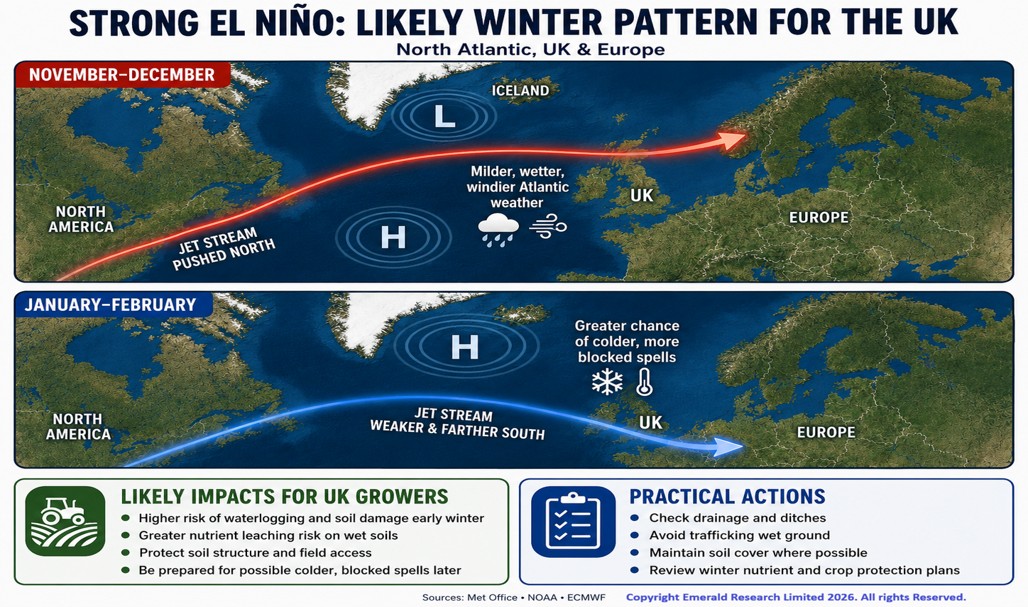
Strong El Niño episodes push the Atlantic jet stream south, increasing the flow of mild, wet, westerly air across the UK from November onward. Historically, that means a wetter, windier early winter, sometimes followed by a colder, more blocked pattern in January and February. And – crucially for vegetable growers – research going back over a century shows a strong statistical link between El Niño winters and above-average spring rainfall across a band from southern England eastward into northern Europe.
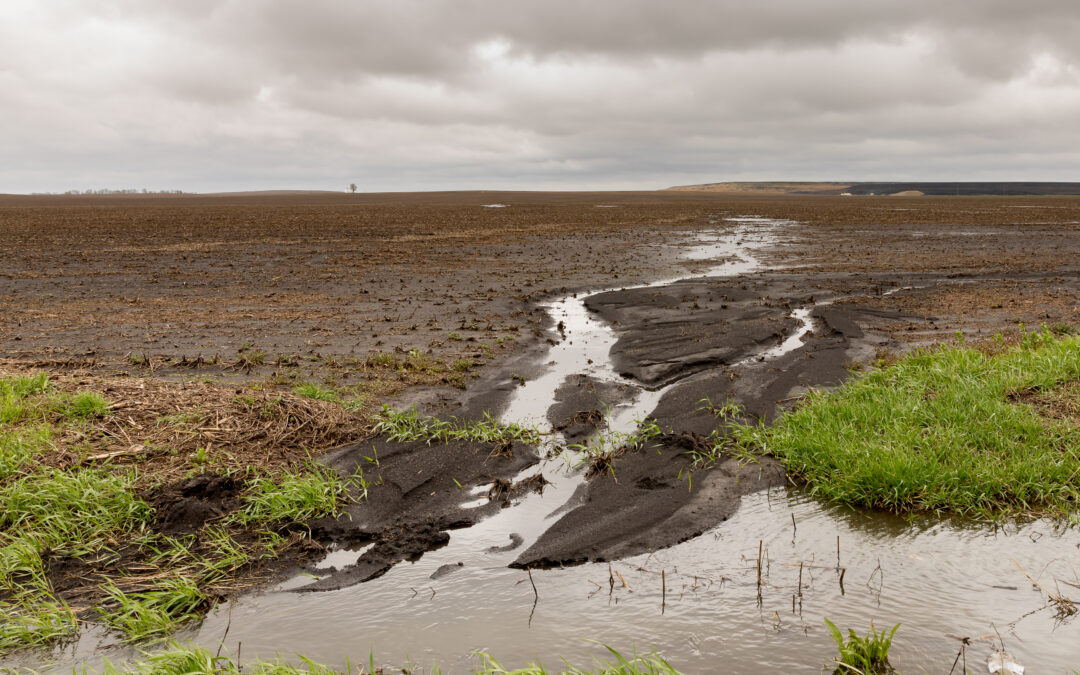
For winter vegetables still in the ground – leeks, brassicas, root crops in store or awaiting lifting – a mild, wet autumn and early winter increases disease pressure, complicates harvesting and damages field conditions for anything that follows. Waterlogged soils lose structure. Compaction from late-season trafficking on saturated ground takes years to undo. Slug pressure climbs in mild, damp conditions – exactly the environment a strong El Niño delivers.
For spring-planted crops, the risk is different but potentially worse.
If the pattern follows historical form, growers may face a wet March and April at precisely the moment they need to be establishing potatoes, carrots, onions and brassica transplants. Delayed planting compresses the growing season, pushes harvest into weather-risk windows and reduces yield potential before the crop has even emerged. On heavier land, there may simply be days – weeks – when you cannot get on the field at all.
And there’s a global dimension.
El Niño disrupts monsoon rainfall across Asia, reduces grain production in Australia and parts of South America and tightens commodity markets – including fertiliser and energy. The Hormuz disruption is already squeezing nitrogen supply and could compound input cost pressure for UK growers through 2027.
This is not meant to be all ‘Doom & Gloom’ as none of this is certain.
El Niño is one driver among many. The Met Office rightly cautions that UK impacts are indirect and variable and every event is different. But the probability is high enough and the historical pattern clear enough that ignoring it would be complacent.
Start now.
If you have a choice of fields for spring-planted crops, prioritise those with better drainage, lighter texture and less flood history – this is not the year to gamble on that heavy clay headland. On fields you know are vulnerable to winter waterlogging or erosion, get a cover crop established before the autumn rains arrive: a cereal or mustard cover will hold soil structure, reduce surface capping, maintain drainage pathways and give you something to incorporate in spring rather than a slumped, sealed surface. Review your autumn cultivation strategy – a well-timed subsoil loosening now, while the ground is dry enough to shatter rather than smear, could make the difference between getting on in March and watching from the gateway. And resist the temptation to travel on saturated ground in winter: the compaction you create in December will still be limiting rooting depth in July.
The growers who handle a wet winter best are not the ones with the most powerful tractors. They are the ones who decided in August which fields to protect, which to sacrifice and which to leave alone until the ground was ready.
Related Reading:
Using Soil Analysis to Build a Potato Nutrition Plan
Why Standard Soil Tests Don’t Tell the Full Story for Crop Nutrition
How Soil Tests Become a Crop Nutrition Plan with OptiYield
Strong Potato Roots: What Early Symposium-Treated Crops Are Showing
From Potatoes to Carrots: Root Crop Agronomy, Soil Biology and Marketable Yield
Microbes for Potato Crops: Stronger Roots and Drought Resilience