
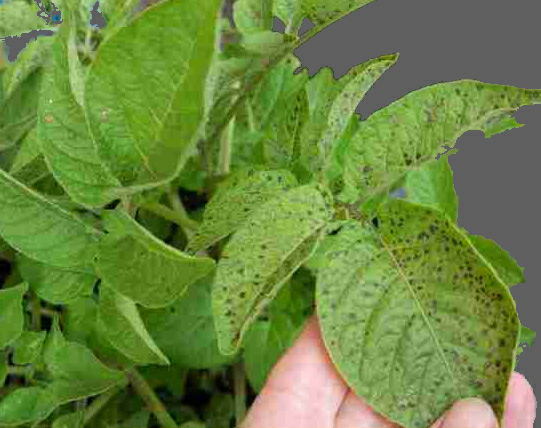
Petiole testing – isn’t just for ‘off colour’ crops.
Petiole testing helps potato growers identify nutrient deficiencies, imbalances and uptake issues before visual symptoms appear. By analysing what the crop is actually taking up during the season, growers can make more informed nutrition decisions to support yield, tuber quality and crop performance.
The majority of macro – and micronutrient deficiency first show themselves in leaf colour changes, stunted growth and deformed stems and tubers.
Macronutrient deficiency symptoms in potatoes
- Nitrogen (N) Deficiency: The whole plant becomes stunted, with older leaves turning pale green or yellow first and often dropping prematurely.
- Phosphorus (P) Deficiency: Plants show stunted growth with dark to dull green foliage, and older leaves may develop purple or red discolouration.
- Potassium (K) Deficiency: Older leaves develop yellowing at the margins that spreads inward between the veins, followed by browning, upward curling, and a stunted, thick-set plant habit.
- Magnesium (Mg) Deficiency: Older leaves show yellowing between the veins, which may progress to brown spotting and a scorched appearance.
- Calcium (Ca) Deficiency: Symptoms appear first in younger, actively growing leaves, which become small, distorted, or hook-shaped. Deficiency can also reduce root development and lead to internal rust spot in tubers.
Micronutrient deficiency symptoms in potatoes
- Iron (Fe) Deficiency: The youngest leaves turn pale green or yellow while the veins remain distinctly green.
- Manganese (Mn) Deficiency: Symptoms begin on younger leaves as yellowing between the veins, often followed by small dark brown or blackish spots.
- Boron (B) Deficiency: Young upper leaves become crinkled, brittle, and misshapen, and the growing points may die back.
- Zinc (Zn) Deficiency: Top leaves may appear small, wrinkled, and yellow, with distorted new growth.
Why visible deficiency symptoms are often too late
By the time a potato crop is showing any of the above signs, nutritional deficiencies are well established and preventing or reversing their detrimental effects on yield and quality may only be partially successful.
Note that some nutrient deficiencies, especially Calcium, cannot be corrected by foliar means or top dressing. Calcium deficiencies can only be addressed before planting.
Why petiole analysis gives earlier insight
Identifying nutrient deficiencies before the visual signs are obvious is easily done through petiole analysis, by analysing the plant’s ‘sap’ it is possible to establish the range and ratios of nutrients that the plant is able to extract from the soil and use. When this is combined with variety-specific nutrient demand growth models it is possible to see if the crop has access to the levels and ratios of nutrients it requires to reach its genetic potential (maximum yields).
Petiole testing isn’t just a rescue tool for crops that already look ‘off colour’; it is a proactive way to keep nutrition on track before yield and quality are compromised. By measuring what the plant is actually taking up and comparing it against variety-specific demand through the season, growers can identify hidden shortfalls, imbalances, or antagonisms early enough to act with confidence.
Supporting yield, quality and genetic potential
In a high-value potato crop, waiting for visible deficiency symptoms often means some potential has already been lost. Regular petiole analysis gives the insight needed to fine-tune nutrition, support tuber development and quality, and help the crop get as close as possible to its full genetic potential.
Related Reading.
Potato Petiole Analysis: Staying on Track from Emergence and Beyond
Using Soil Analysis to Plan Nutrition and Inputs for Potatoes
How to Take Soil Samples That Improve Potato Yield and Tuber Consistency
Why Standard Soil Tests Don’t Tell Potato Growers What They Need to Know
Foliar Application in Wet and Dry Weather | Crop Nutrition